
The PPWR Era

As the EU’s Packaging and Packaging Waste Regulation (PPWR) moves into its phased implementation, the logic behind packaging material evaluation is undergoing a structural shift. Traditional regulations focused primarily on waste management; however, the PPWR extends its scope to the product design phase, making material selection a critical condition for compliance.
For enterprises targeting the European market, packaging materials must do more than meet safety and performance standards—they must be effectively sortable and recyclable within existing systems, while containing a mandatory percentage of Post-Consumer Recycled (PCR) content. Consequently, material evaluation criteria are evolving from "Is it usable?" to "Can it operate consistently under circular conditions?"
New Requirements Imposed by PPWR
As an EU-level regulation, the PPWR applies directly to all member states. Its core objective is not merely to encourage recycling, but to mandate that packaging materials are recycled and actually re-enter the circular economy.
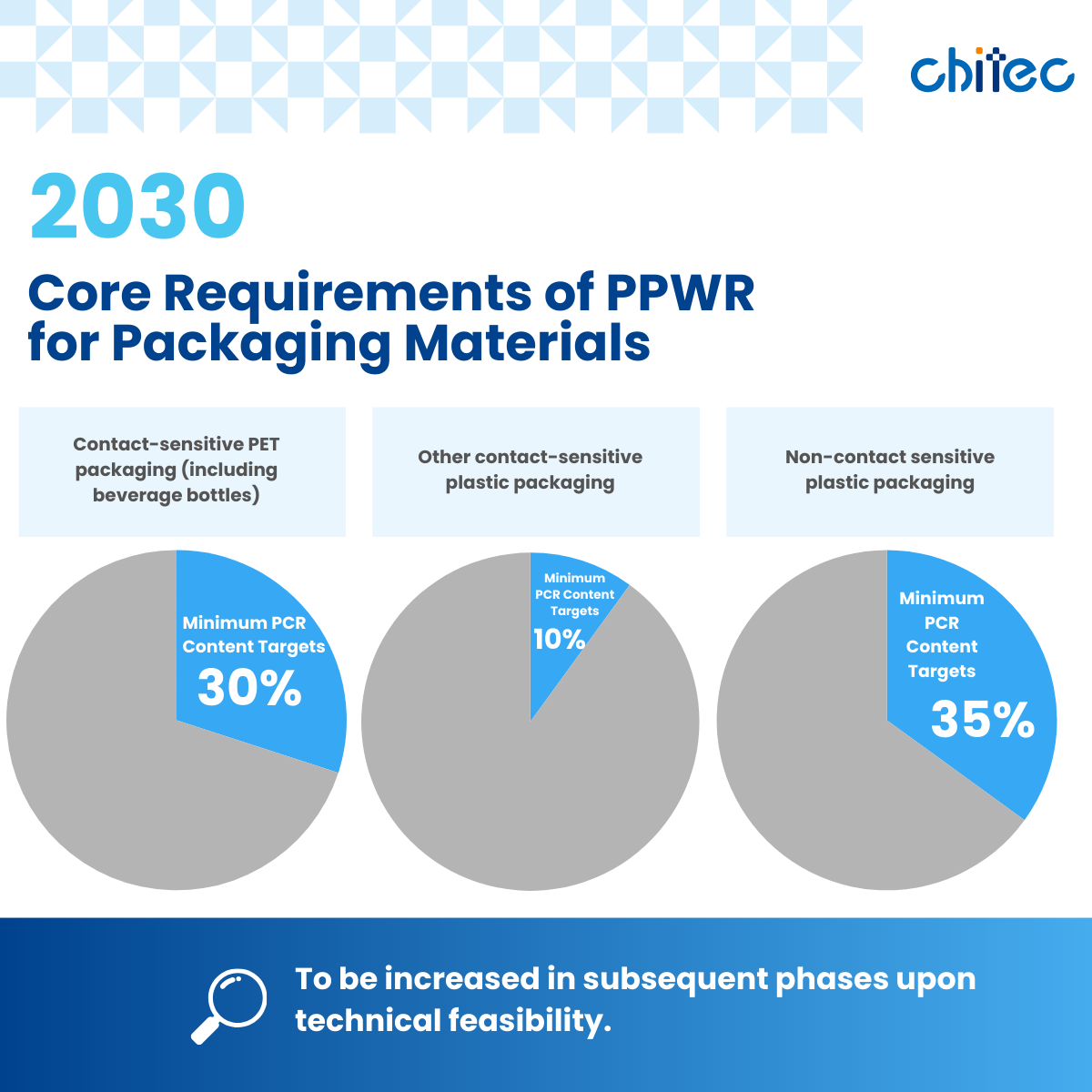
For plastic packaging, the regulation mandates minimum PCR content targets starting in 2030, with increased ratios by 2040. Targets typically include approximately 30% PCR for contact-sensitive PET packaging, 10% for other contact-sensitive plastic packaging, and up to 35% for non-contact sensitive plastic packaging.
Under this framework, the challenge for manufacturers is no longer just sourcing recycled resins, but ensuring long-term stability when using recycled materials within established production processes and specifications.
From PIR to PCR: Increasing Material Complexity
Most enterprises begin their circular transition with PIR (Post-Industrial Recycled) materials. PIR typically originates from production scrap or industrial waste, offering clear traceability and additive systems consistent with virgin resins, making it relatively predictable.
However, even PIR has undergone at least one thermal processing cycle. During high-temperature processing, polyolefins gradually accumulate thermal-oxidative history, leading to chain scission, which results in drifts in melt flow and mechanical properties.
When transitioning to PCR (Post-Consumer Recycled), complexity increases significantly. PCR is derived from diverse products with varying service lives and processing cycles. Even when categorized as the same polymer (e.g., PE or PP), PCR exhibits significant variations in molecular weight distribution, oxidation levels, and additive backgrounds. The primary challenge shifts from performance degradation to material behavior volatility.

PCR Disrupts Traditional Processing Assumptions
Traditional plastic processing assumes that raw materials possess stable and predictable characteristics. PCR breaks this premise. Since recycled materials come from diverse sources, their oxidation levels and molecular weight distributions fluctuate, shifting production risks from average performance to volatility itself.
This leads to frequent adjustments of processing temperatures, inconsistent melt flow and dimensional shrinkage, and wider batch-to-batch variations in appearance and impact strength. In the circular era, the critical capability for a material is no longer just its peak performance, but its predictability.
Core Challenges in Recycled Material Processing
In polymer processing, the most common cost pressures arise from the autoxidation cycle triggered by heat, oxygen, and shear. During extrusion or injection molding, the rapid accumulation of hydroperoxides leads to discolouration (yellowing) and loss of mechanical integrity.
These issues are amplified when introducing PIR or PCR. Recycled materials carry a significant oxidative history; residual hydroperoxides easily trigger further degradation during subsequent processing, making it difficult to maintain color stability and a wide processing window.
Revonox® 608
Featuring high phosphorus density and superior thermal stability, Revonox® 608 rapidly decomposes hydroperoxides and inhibits the autoxidation cycle. This assists PIR/PCR-containing systems in maintaining stable processing performance and consistent product quality.
Product Intro: Revonox 608Polyolefin Stabilization Designed for Circularity
In polyolefin applications, the choice of antioxidant directly dictates color stability and processing consistency. While traditional phenolic antioxidants provide protection, they are prone to gas-fading or yellowing under certain conditions.
Revonox® 420V
Chitec’s innovative phenol-free antioxidant is based on bio-sourced palm oil and utilizes DAHA® technology to quench free radicals. Beyond mitigating gas-fading, it maintains exceptional color stability even during multiple extrusions or high-speed processing.
This ensures that applications such as PP/PE fibers, films, and automotive TPO maintain premium aesthetics and stability, even with the incorporation of recycled content.
Product Intro: Revonox 420VRevonox®: Making Recycled Materials "Manageable"
The Revonox® series is specifically engineered for the rigors of recycling. Its goal is to mitigate processing drifts caused by the varying oxidative histories of PCR. Through radical scavenging and peroxide decomposition, Revonox® helps maintain consistent melt flow and minimizes batch-to-batch variance in color and mechanical properties.
When material behavior becomes stable, manufacturers can re-establish processing windows and Statistical Process Control (SPC). The value of recycled material is thus determined not just by price, but by its controllability and predictability.
Competitive Differentiation in the PPWR Era

In the PPWR era, competitive advantage will be defined not just by the *use* of PCR, but by the capability to use PCR stably. Companies that integrate recycled materials into long-term supply and quality management systems will lead the circular economy.
Revonox® transforms recycled content from "usable materials" into "manageable materials," enabling enterprises to meet regulatory mandates while maintaining production efficiency, quality consistency, and product reliability.
Contact Us
To evaluate and establish a stable processing window for high-content PCR applications,
Please contact Chitec's Technical and Sales Team:
📩 sales@chitec.com
建議您使用以下瀏覽器觀看本網站,
要下載瀏覽器,請直接點擊以下:以獲得最佳瀏覽效果。