
📘 “Six Causes of Plastic Yellowing”
Part 5: Gas Fading
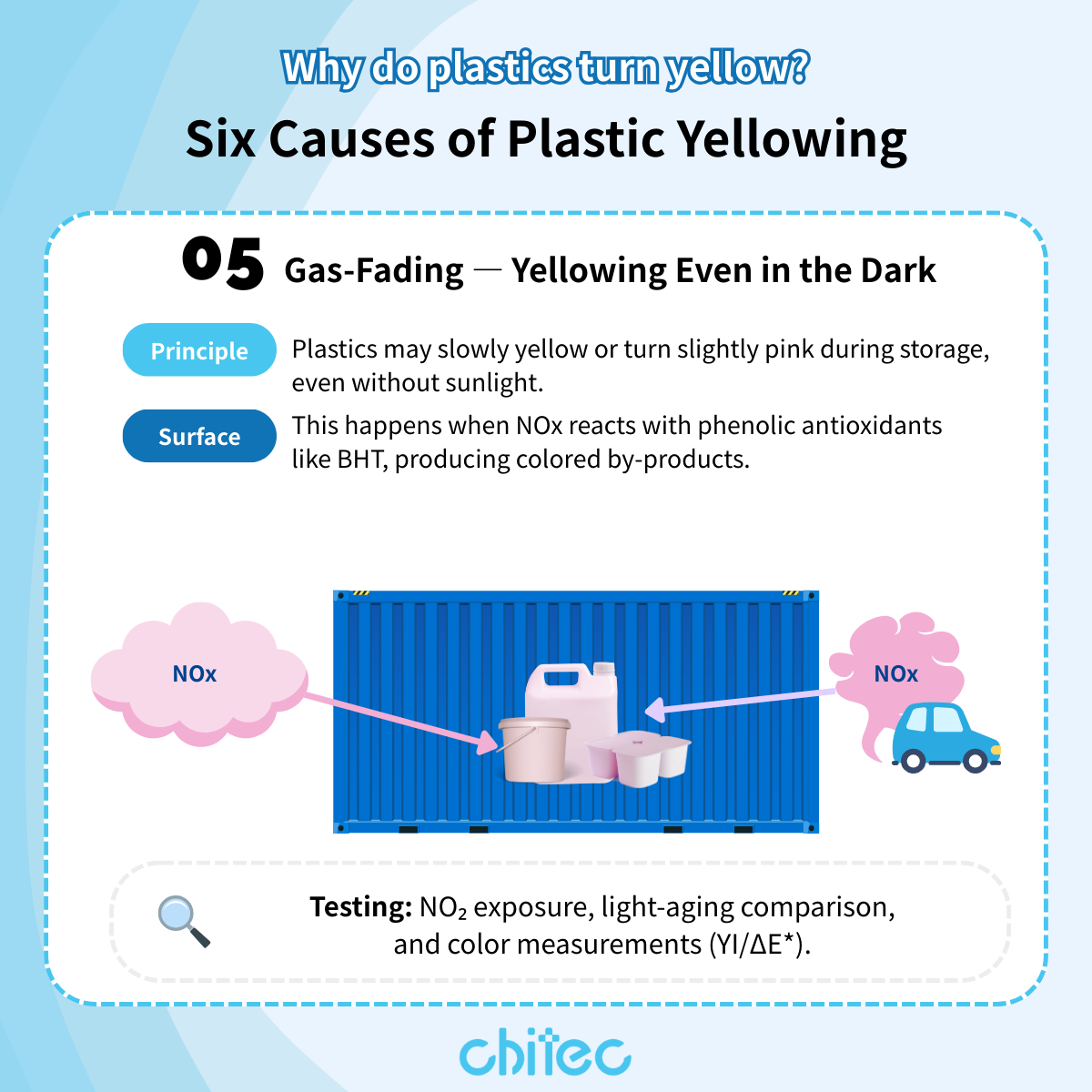
Gas-Fading: Yellowing Even in the Dark
Some plastic products can gradually turn yellow—or even slightly pink—during storage or transportation, even without sunlight exposure. The real culprit behind this change is often air pollutants.
Nitrogen oxides (NOx) in the air (mainly from vehicle exhaust and construction site fumes) can react with phenolic antioxidants (such as BHT), generating colored by-products. This reaction continues even in dark environments, meaning materials stored in warehouses or shipping containers may “slowly discolor” unnoticed.
Common Materials and Scenarios
• Polyolefins (PP, PE) containing phenolic antioxidants (e.g., BHT): Items stored near high-traffic or polluted areas easily turn yellow or slightly pink.
• Long-distance transported products: Materials kept in containers or warehouses for extended periods may exhibit color shift even without light exposure.
🔍 Testing Insights: How to Confirm Gas Fading?
- NO₂ exposure test: Place the material in a controlled nitrogen dioxide environment. Significant yellow or pink discoloration indicates NOx sensitivity.
- Comparison with light-aging tests: If discoloration is prominent under “no light + high NOx” but minimal under “light only,” the effect is confirmed as gas-fading.
- Color measurement (YI, ΔE*): Use a colorimeter for quantitative tracking and avoid visual bias.
👉 Summary: Gas-fading is a commonly overlooked yet real factor in plastic yellowing. Beyond light and heat, air pollution can also accelerate the aging process.
Read more –
Six Causes of Plastic Yellowing Part 1: Photo-oxidation
Six Causes of Plastic Yellowing Part 2: Thermal Oxidation
Six Causes of Plastic Yellowing Part 3: The “Side Effect” of Antioxidants
Six Causes of Plastic Yellowing Part 4: Additives and Impurities
Six Causes of Plastic Yellowing Part 6: Inherent Aging Characteristics of Materials
The Science of Stability: How UV Absorbers Extend Material Performance
🔹Chitec Technology | The Expert in Anti-Aging Solutions for Materials
Product Recommendation – Revonox® 420V: Sustainable, Phenol-Free Antioxidant Solution
Revonox® 420V is Chitec Technology’s innovative, phenol-free antioxidant derived from palm oil, offering a sustainable alternative to traditional tallow-based antioxidants.
As an eco-friendly antioxidant developed using natural palm oil, Revonox® 420V provides a reliable replacement for conventional phenolic or tallow-based antioxidants in plastic applications. It excels in melt-processing stability, gas-fading resistance, and long-term color retention.
Powered by Chitec’s proprietary DAHA® technology, Revonox® 420V effectively addresses yellowing issues commonly caused by phenolic antioxidants, making it an ideal choice for polypropylene (PP) and polyethylene (PE) applications.
- Phenol-Free to Prevent Yellowing
- Synergistic Stability in Processing
- Exceptional High-Temperature Color Stability
- Eco-Friendly with Low Migration
建議您使用以下瀏覽器觀看本網站,
要下載瀏覽器,請直接點擊以下:以獲得最佳瀏覽效果。