
How Can Black UV Inks Be Cured Effectively?
Overcoming Optical Barriers in Dark Pigments Through Photoinitiator Selection
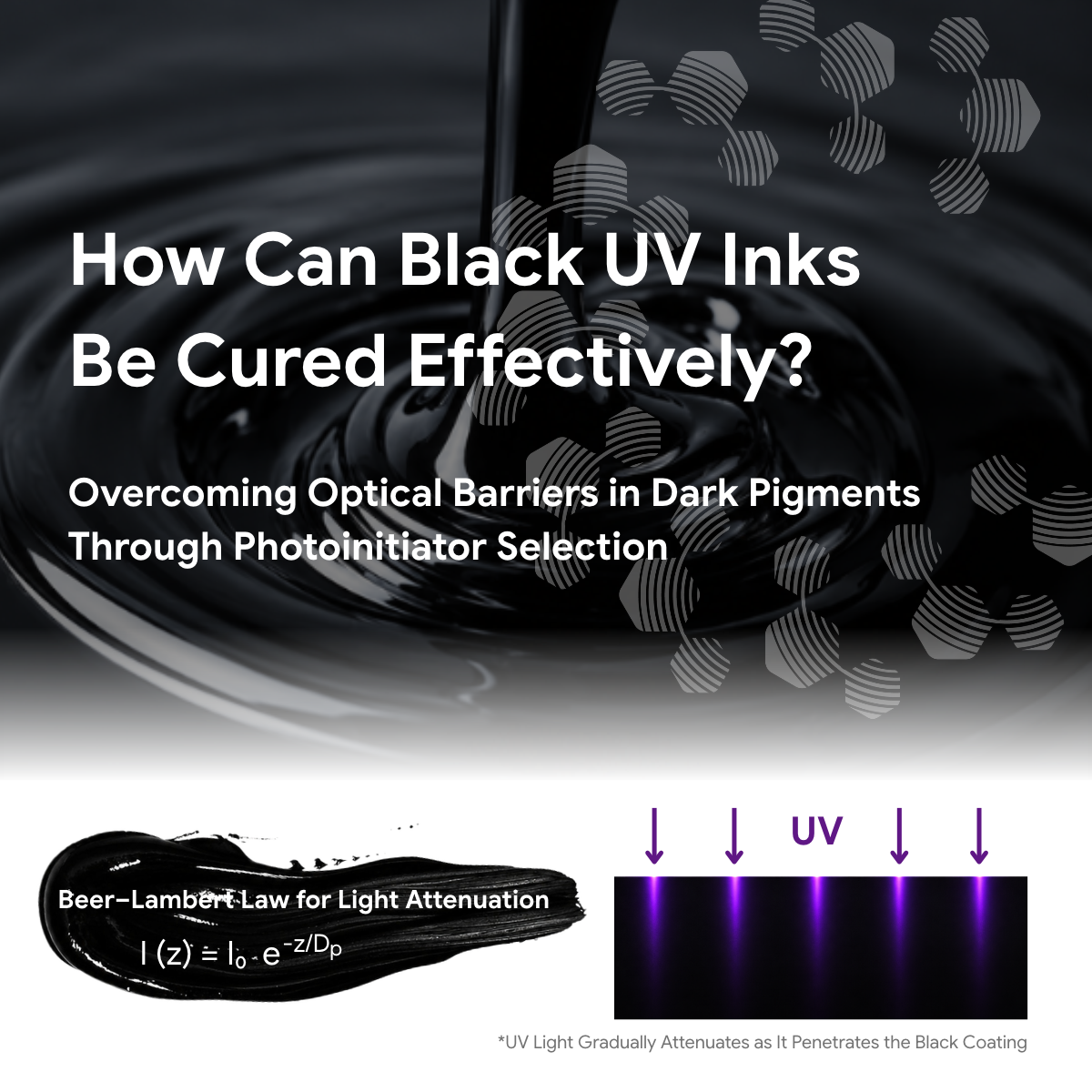
As UV-curing technology becomes increasingly common in industrial inkjet printing, electronic component marking, packaging printing, and functional coatings, ink and coating manufacturers face a critical challenge: improving production efficiency without compromising curing consistency. Black and dark-colored UV inks, in particular, present greater optical challenges than clear or lightly pigmented formulations because of their high concentrations of light-absorbing pigments.
Black inks typically rely on carbon black to deliver high opacity, rich color density, and strong visual contrast. However, carbon black absorbs light across a broad spectral range, including visible light and part of the energy emitted by UV-curing sources. As light penetrates a heavily pigmented ink film, the pigments absorb a portion of the incident energy, leaving less light available to reach the deeper layers and activate the photoinitiators.
This uneven distribution of light energy can produce a film that appears cured at the surface while remaining insufficiently polymerized underneath. The resulting undercure may compromise adhesion, abrasion resistance, chemical resistance, and long-term performance reliability.
A 2025 study published in MRS Communications reported that light-absorbing fillers influence the depth of cure in photocurable resins, highlighting the close relationship between a material’s optical properties and its curing behavior.[1]
UV curing is a light-initiated polymerization process. When a free-radical photoinitiator absorbs light at an appropriate wavelength, a photochemical reaction generates reactive radicals. These radicals initiate the polymerization and crosslinking of acrylate monomers and oligomers, converting the liquid ink into a solid film.
In clear or lightly pigmented formulations, light can generally penetrate the coating more readily, allowing photoinitiators at different depths to receive sufficient energy.
In black and highly opaque UV inks, however, carbon black competes with photoinitiators for incident light. As pigment concentration increases, light attenuation within the film generally becomes more pronounced, limiting photoinitiation in the deeper layers.
In a simplified model of uniform absorption, the decrease in light intensity with penetration depth can be described by the Beer–Lambert law:
Here, I₀ represents the incident light intensity, I(z) is the light intensity at depth z, and α is the effective light attenuation coefficient at a given wavelength.
As the effective attenuation coefficient increases, the depth to which light can penetrate decreases. In practice, however, pigmented inks may also exhibit light scattering, exposure to multiple wavelengths, and changes in optical properties during curing. A single attenuation coefficient therefore cannot fully describe every aspect of their curing behavior.
In their 2025 study, Wieckowski and Erb examined how light-absorbing fillers affect the cure depth of photocurable resins and demonstrated that filler optical properties can be used to adjust curing depth.[1]
Although the research focused primarily on materials used in vat photopolymerization, the underlying light attenuation mechanism also helps explain the competition for light energy between pigments and photoinitiators in black UV inks. For ink manufacturers, this means that increasing pigment concentration to improve opacity must be accompanied by an assessment of whether the curing light source and photoinitiator system can still deliver adequate reaction efficiency.
Surface Cure vs. Through Cure: Why a Dry Surface Does Not Mean Complete Curing
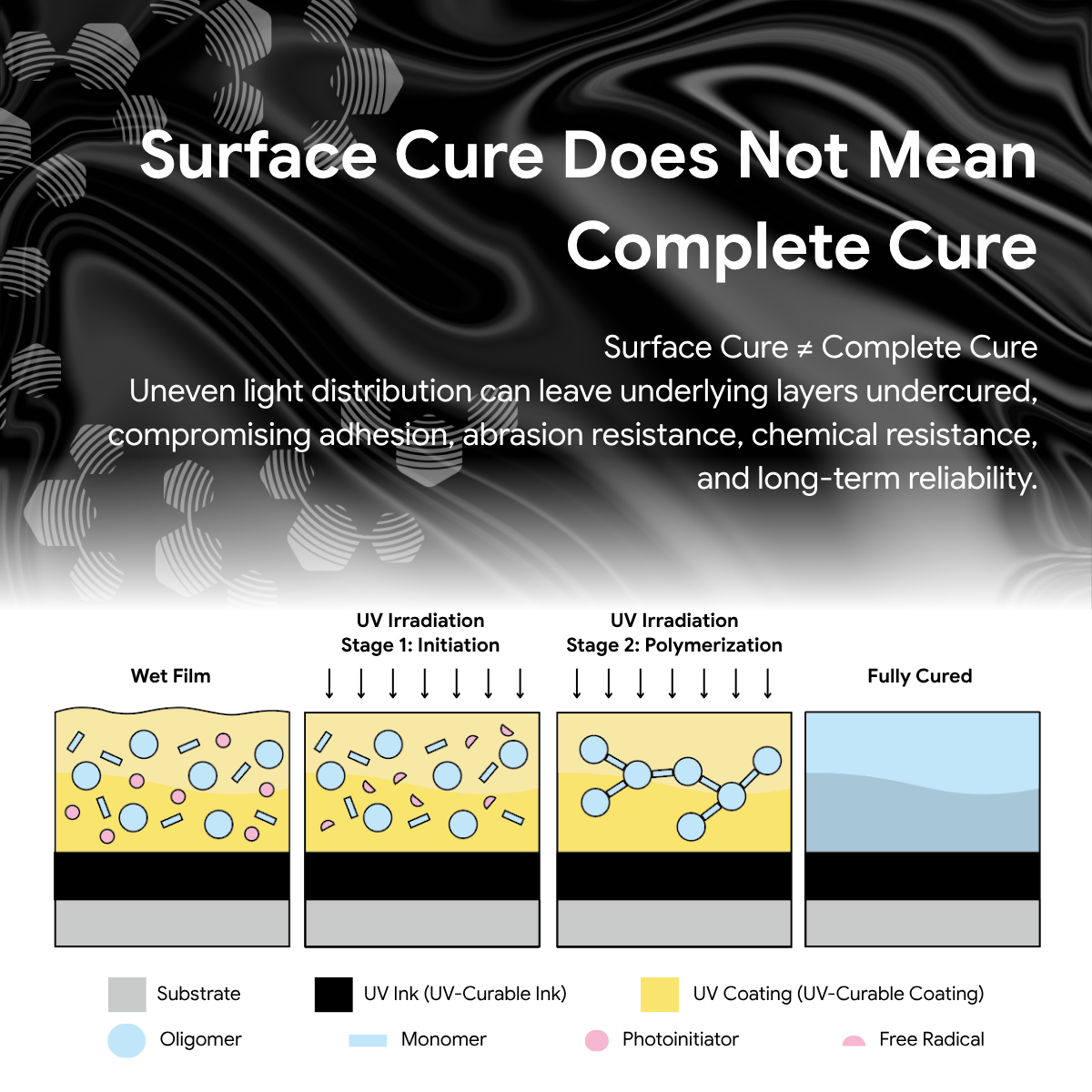
Another common challenge in black UV inks is the difference between surface cure and through cure.
In practical applications, insufficient curing in the lower layers can reduce adhesion, abrasion resistance, and chemical resistance, while also increasing the risk of residual unreacted components.
A 2025 study published in ACS Applied Polymer Materials investigated changes in optical behavior during free-radical photopolymerization. It found that light absorption and scattering affect the transport of light through the material and that these optical properties may evolve as polymerization proceeds.[3]
Can Increasing Photoinitiator Loading Improve the Cure of Black UV Inks?
Increasing photoinitiator loading is a common formulation adjustment when black UV inks exhibit insufficient cure. Yet photoinitiators must first absorb light at suitable wavelengths to generate reactive radicals. If carbon black has already absorbed a substantial share of the incident light, adding more photoinitiator does not necessarily increase the usable energy reaching the bottom of the film. The relationship between photoinitiator concentration and cure depth is therefore not necessarily linear.
Highly Opaque Formulations Require a More Comprehensive Photoinitiator Strategy
The curing efficiency of black UV inks depends on several interconnected factors: the photoinitiator absorption spectrum, radical generation efficiency, pigment light absorption, film thickness, and the spectral output of the curing equipment.
An effective photoinitiator system should therefore be designed not only for strong light absorption, but also for the distribution of usable light to the regions where polymerization must take place.
In some highly opaque formulations, combining photoinitiators with complementary absorption characteristics may offer greater flexibility in formulation design. Any performance benefit, however, must be verified through measurements of conversion, cure depth, and final product properties.
UV-LED Wavelength Matching: Choosing Photoinitiators for Dark-Colored Inks
UV-LED curing commonly uses light sources centered at 365, 385, 395, or 405 nm. Compared with conventional UV mercury lamps, which emit across a broader spectrum, UV LEDs typically produce light within a narrower wavelength range. Matching the photoinitiator’s absorption characteristics to the light source is therefore especially important.
Photoinitiator selection should not be based solely on the wavelength of maximum absorption (λmax). The degree of overlap between the photoinitiator absorption spectrum and the actual emission spectrum of the curing source must also be considered.
In black UV inks, carbon black also absorbs part of the light within these same wavelength ranges. Consequently, even when a photoinitiator absorbs a particular wavelength, that wavelength may not penetrate a heavily pigmented film effectively.
Formulators must evaluate the optical interactions among the photoinitiator, pigment, and light source, then use practical curing tests to determine the most suitable wavelength and exposure conditions.
Why Do Photoinitiator Solubility and Formulation Compatibility Matter?
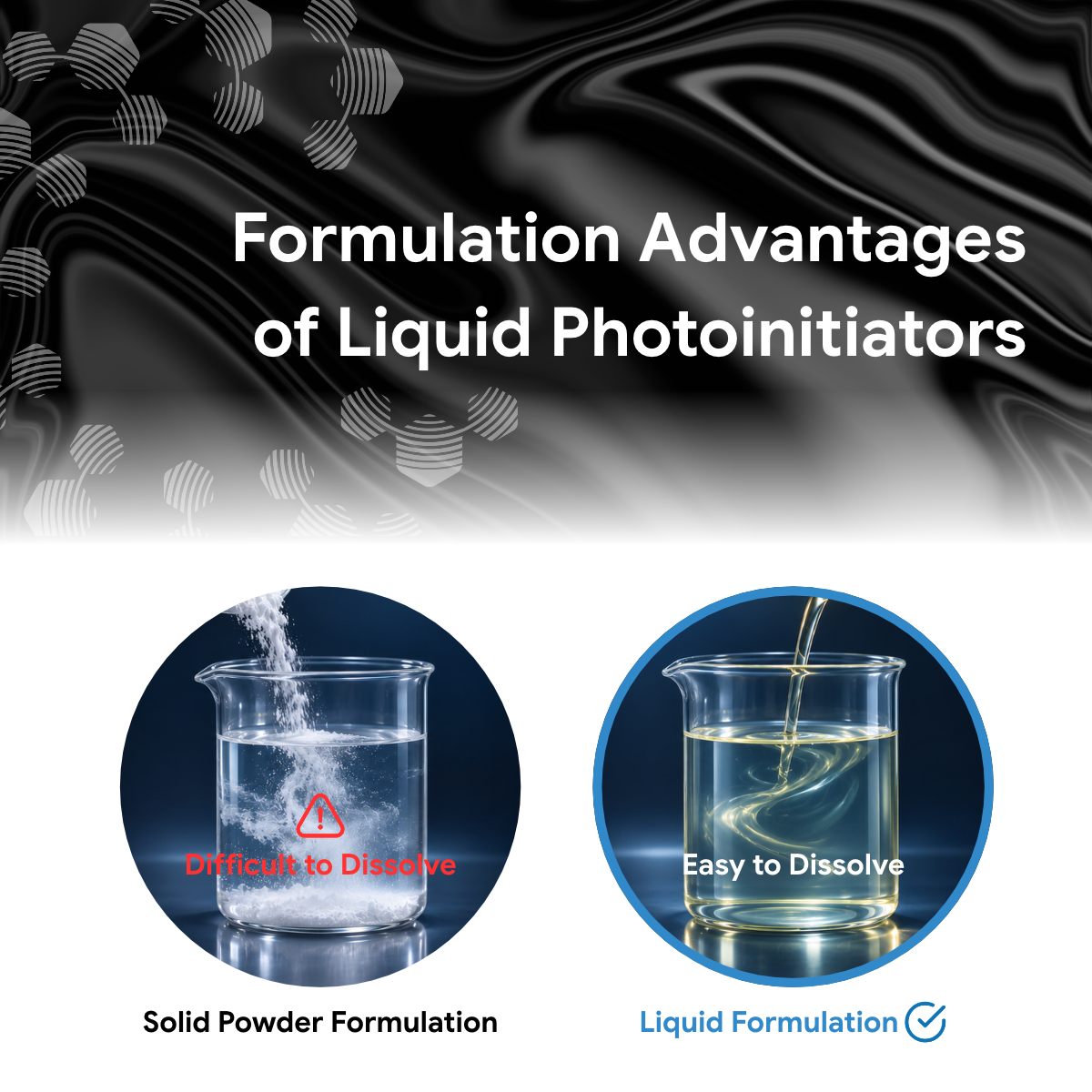
Beyond photochemical efficiency, the solubility and compatibility of a photoinitiator within the ink formulation are important to processing stability. Some solid photoinitiators have limited solubility in certain acrylate monomers or oligomers and may require additional heating or mixing to achieve a sufficiently uniform formulation.
A liquid photoinitiator that remains compatible with the formulation’s monomers and oligomers may therefore simplify the dissolution process and provide greater flexibility in formulation development.
Balancing Carbon Black Concentration, Film Thickness, and UV-Curing Conditions
The opacity of black UV inks is closely related to the type and concentration of carbon black, pigment dispersion, and film thickness. Increasing carbon black content may improve hiding power, but it can also increase light absorption and make through cure more difficult.
To address the challenges of curing efficiency, photoinitiator solubility, and formulation stability in black and highly opaque UV inks, Chitec offers R-gen® 919 liquid photoinitiator as an additional photoinitiator option for acrylate-based systems.
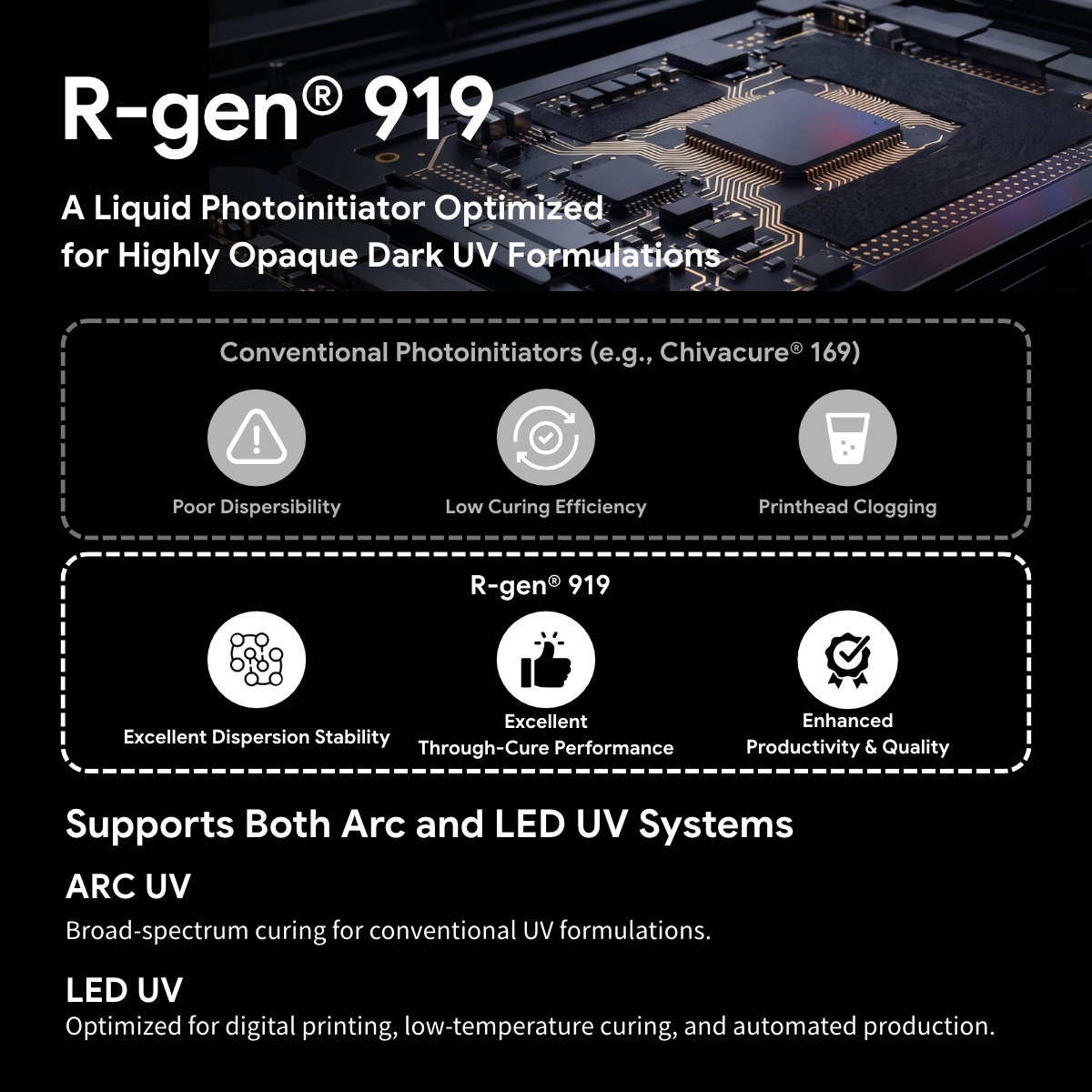
Key technical characteristics of R-gen® 919 include its liquid form, compatibility with most acrylate systems, and application performance under specified UV arc-lamp and LED-curing conditions.
Compared with certain conventional solid photoinitiators, the liquid form of R-gen® 919 helps reduce solubility-related limitations, giving formulators greater freedom to optimize the photoinitiator system. For UV ink manufacturers, this can facilitate raw-material incorporation, reduce the risk of precipitation caused by insufficient photoinitiator solubility, and broaden the available formulation options.
Supporting the Curing Requirements of Highly Opaque Black UV Inks
Black and highly opaque UV inks must achieve the required degree of polymerization even when pigments absorb a substantial portion of the available light. R-gen® 919 can be used in highly opaque black UV systems, with application test information available for UV arc-lamp curing and 365/395 nm LED-curing conditions. Manufacturers using UV-LED equipment are encouraged to conduct formulation-specific tests to confirm compatibility with their existing photoinitiator systems, curing speed, and finished-product performance.
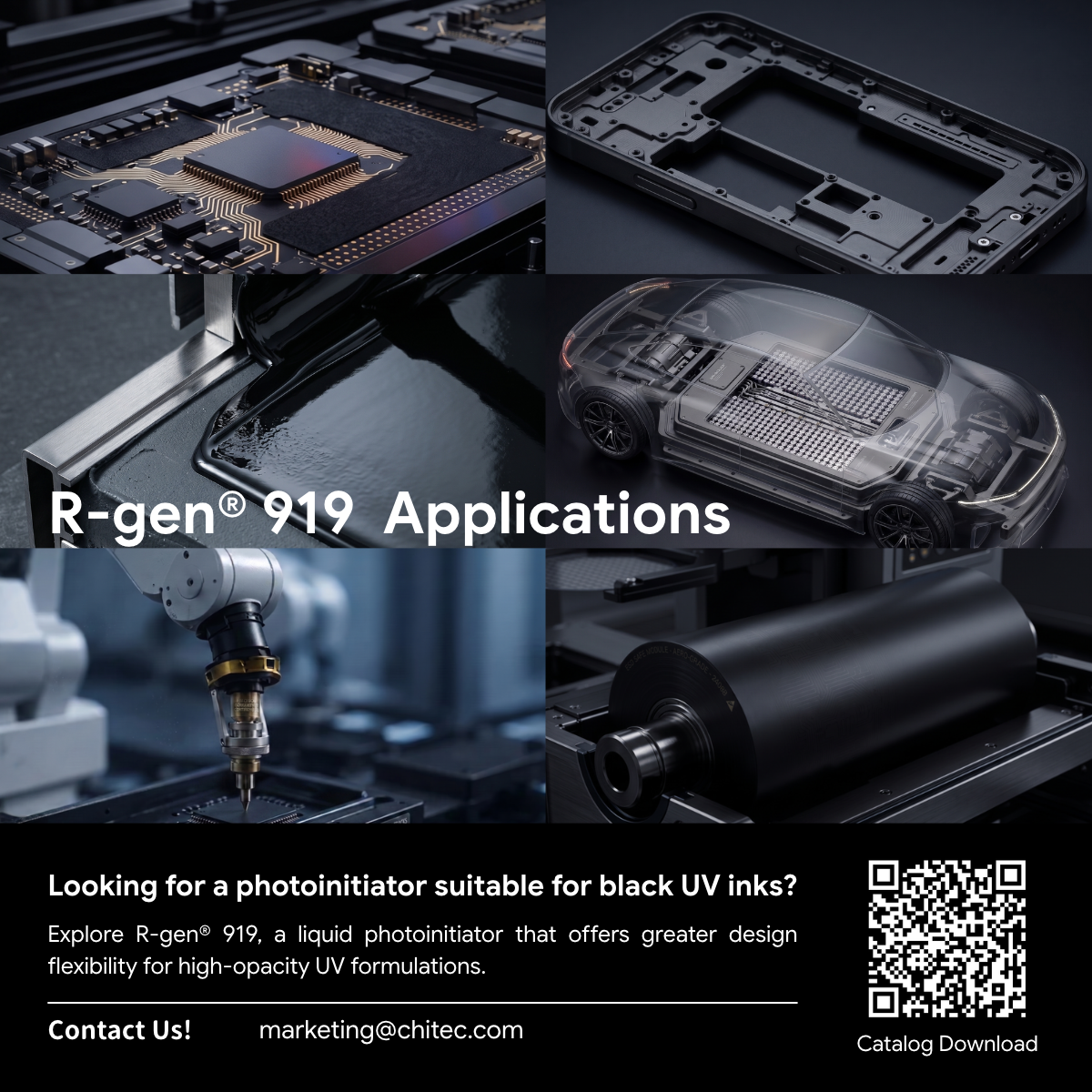
Applications of R-gen® 919 in UV Inks and Industrial Coatings
- Black UV Inkjet Inks
- UV Marking Inks for PCBs and Electronic Components
- Highly Pigmented UV Coatings and Industrial Printing
Looking for a Photoinitiator for Black UV Inks?
Contact the Chitec technical team to learn more about the properties of R-gen® 919, its suitability for your formulation, and available curing test information. Together, we can explore a photoinitiator solution that meets your processing requirements.
Explore R-gen® 919 Product Information
References
[1] Wieckowski, H. S., & Erb, R. M. (2025). Tuning depth of cure in resins with photoabsorbing fillers for vat photopolymerization. MRS Communications, 15, 308–319. https://doi.org/10.1557/s43579-025-00713-0
[2] Kim, Y., & Sobhani, S. (2025). Nonlinear light attenuation curing effects in vat photopolymerization. Additive Manufacturing, 109, 104857. https://doi.org/10.1016/j.addma.2025.104857
[3] From Light to Kinetics: Studying the Optics of Radical Photopolymerization Evolution. (2025). ACS Applied Polymer Materials, 7(17), 11777–11786. https://doi.org/10.1021/acsapm.5c02250
[4] Bednarczyk, P., & Rożniakowski, K. (2025). The Influence of the Photoinitiating System on Residual Monomer Contents and Photopolymerization Rate of a Model Pigmented UV/LED Nail Gel Formulation. Coatings, 15(10), 1125. https://doi.org/10.3390/coatings15101125
[5] Petrič, M., et al. (2025). Selection of photoinitiators for UV-LED curing of white pigmented coatings: A case study of industry-academia collaboration. IOP Conference Series: Materials Science and Engineering, 1339, 012032. https://doi.org/10.1088/1757-899X/1339/1/012032
建議您使用以下瀏覽器觀看本網站,
要下載瀏覽器,請直接點擊以下:以獲得最佳瀏覽效果。