
PVB Laminated Glass: From Safety Protection to Long-Term UV Resistance in Material Design
As automotive and architectural glass trends toward larger surface areas, high transparency, safety, and multi-functionality, glass no longer serves solely to provide natural light and visibility. From automotive windshields and panoramic sunroofs to architectural curtain walls and skylights, glass must maintain outstanding optical performance while balancing impact safety, post-breakage protection, and long-term durability.
Driven by these demands, laminated glass has become a crucial safety glass solution for both automotive and architectural applications.
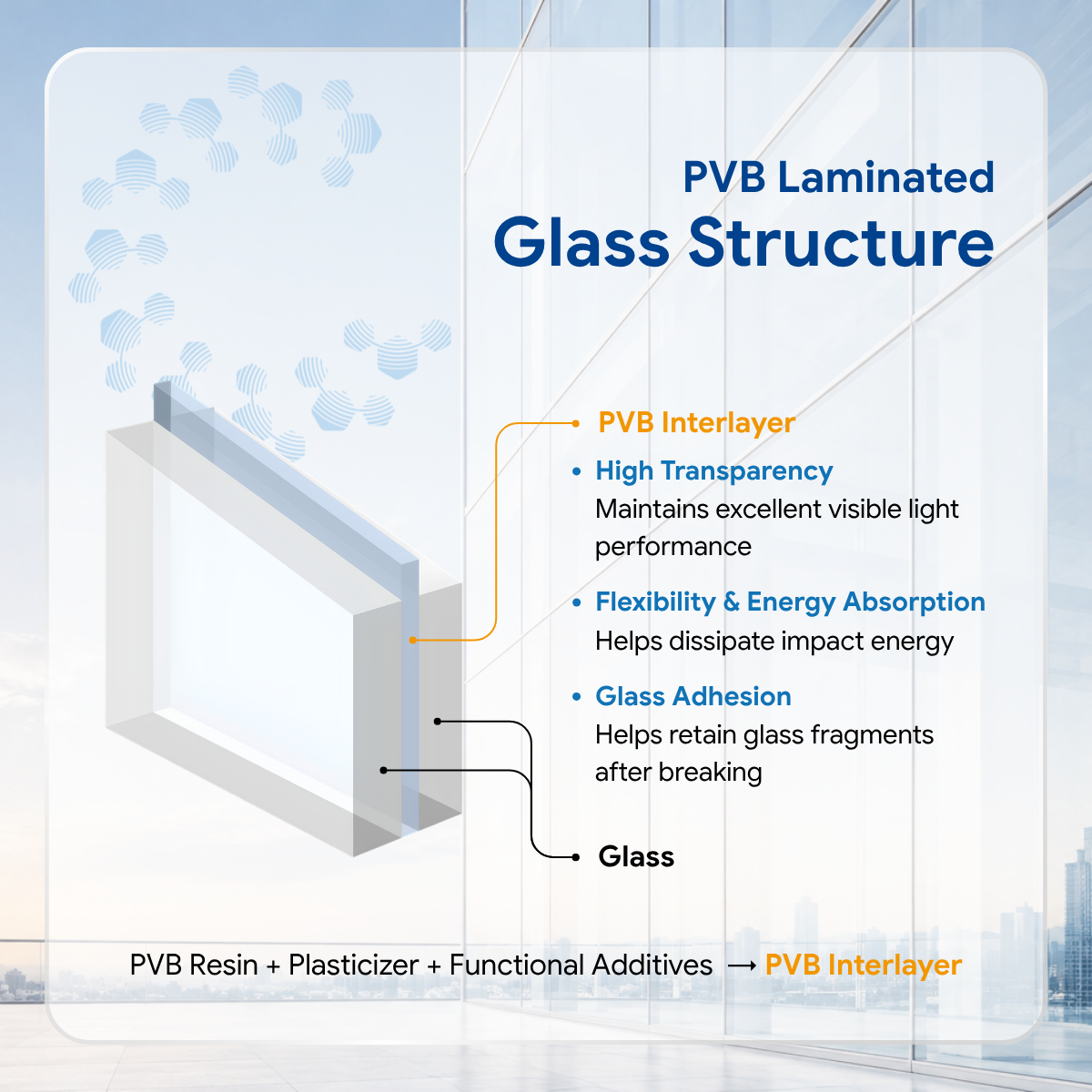
Laminated glass is typically created by inserting a polymer interlayer between two or more sheets of glass, followed by heating and pressure processes that form an integrated composite structure. Among available materials, Polyvinyl Butyral (PVB) has become the most widely used interlayer material due to its excellent transparency, glass adhesion, flexibility, and impact-resistant performance.
A typical structure can be represented as:
What appears to be a simple transparent film is, in reality, a critical material that influences the safety, optical clarity, and long-term durability of laminated glass.
Why Is PVB Ideal for Laminated Glass?
Standard glass possesses great transparency and rigidity, but when subjected to sufficient external force, it shatters into sharp shards, posing significant safety hazards.
Incorporating a PVB interlayer fundamentally changes how glass behaves upon fracturing.
When laminated glass sustains an impact and fractures, the flexible PVB interlayer absorbs and dissipates a portion of the impact energy. Concurrently, strong interfacial adhesion between PVB and glass keeps broken glass fragments bonded to the interlayer. This allows the assembly to maintain structural integrity post-breakage, greatly minimizing the safety risks associated with flying glass shards.
This key characteristic explains why PVB has long been the gold standard for automotive windshields and architectural safety glass.
Beyond continuous advancements in material properties, global safety standards for vehicles and buildings, along with rising demand for high-performance functional glass, continue to drive market growth for PVB interlayers and laminated glass.
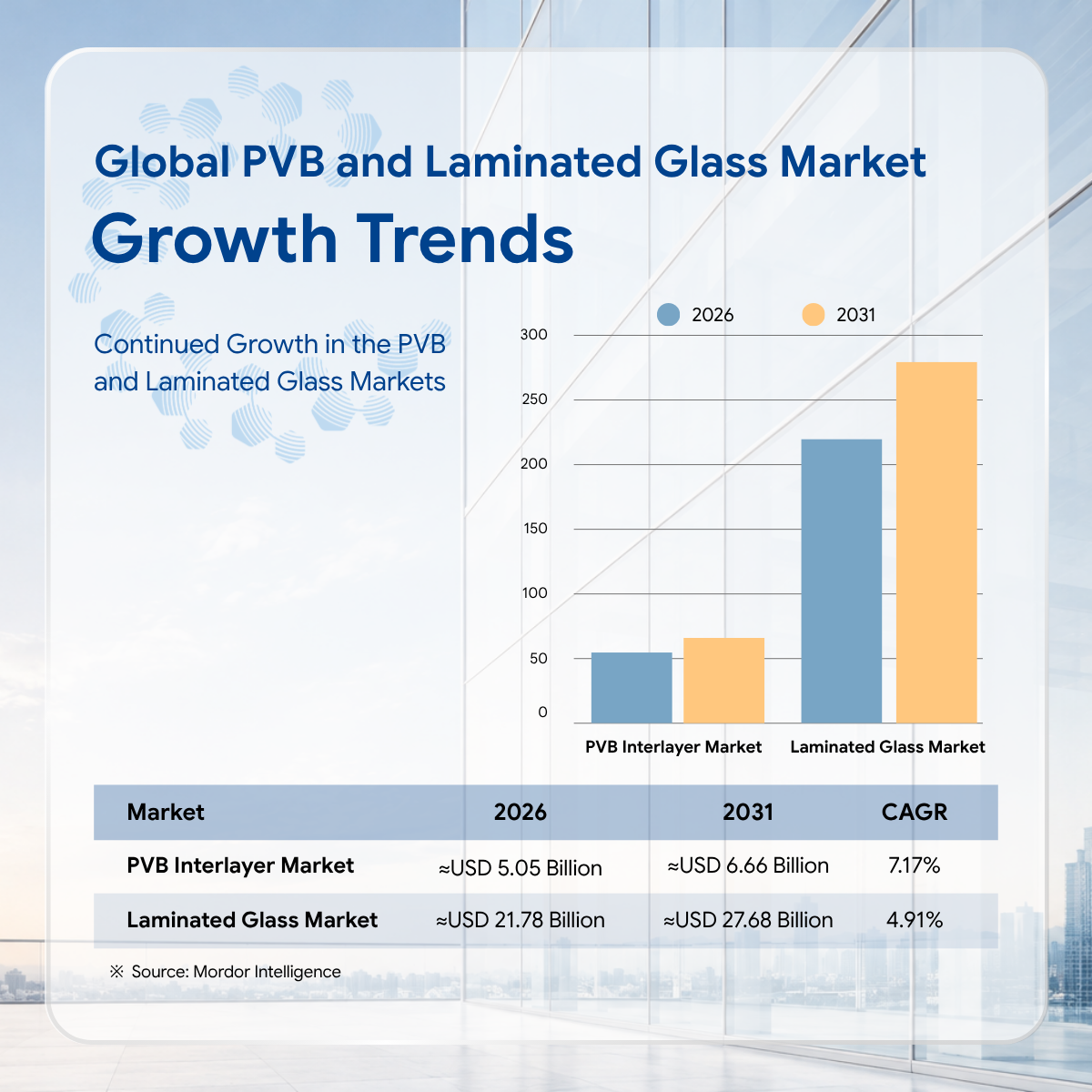
According to market research data, the global PVB interlayer market is projected to expand from approximately USD 5.05 billion in 2026 to USD 7.14 billion by 2031, reflecting a compound annual growth rate (CAGR) of 7.17%. Meanwhile, the global laminated glass market is expected to grow from roughly USD 21.78 billion in 2026 to USD 27.68 billion by 2031, at a CAGR of 4.91%.
| Market | 2026 Market Size (Est.) | 2031 Market Size (Est.) | CAGR |
|---|---|---|---|
| PVB Interlayer Market | ~ USD 5.05 Billion | ~ USD 7.14 Billion | 7.17% |
| Laminated Glass Market | ~ USD 21.78 Billion | ~ USD 27.68 Billion | 4.91% |
Behind this market growth is not merely an increase in safety glass volume, but shifting performance expectations. The automotive sector continues to expand the adoption of windshields, panoramic roofs, and other large glass surfaces, while architectural design prioritizes safety, sound insulation, energy efficiency, and high-performance glazing. These trends place higher demands on the clarity, durability, and functional customization of PVB interlayers.
The Asia-Pacific region currently stands as a key regional market for both PVB interlayers and laminated glass. As automotive and architectural applications evolve, optimizing interlayer formulations to boost safety, optical performance, and long-term protection has become a primary focus for material developers.
High Transparency and Superior Optical Performance
For automotive windshields, architectural windows, or glass curtain walls, the interlayer must not compromise original glass clarity or visual fidelity.
PVB exhibits outstanding optical clarity. Under proper formulation and lamination processing, it forms a uniform, highly transparent middle layer that preserves high visible light transmittance and clean aesthetics while enhancing safety.
Consequently, PVB is uniquely suited for glass products where uncompromised safety and high transparency are required simultaneously.
Flexibility and Impact Energy Absorption
Another essential attribute of PVB is its excellent flexibility and viscoelasticity.
In practice, commercial PVB interlayers consist of more than pure PVB resin; they are compounded with plasticizers to tailor the glass transition temperature, softness, processability, and mechanical strength.
Properly plasticized PVB interlayers deform under impact forces, effectively absorbing and dissipating kinetic energy.
Hence, commercial PVB interlayers are best understood as engineered material systems:
This highlights that beyond the intrinsic properties of PVB resin, the choice of functional additives plays a crucial role in determining processing ease, optical clarity, and long-term durability.
Key Application Fields for PVB Laminated Glass
By offering a combination of transparency, strong adhesion, flexibility, and impact resistance, PVB laminated glass is widely deployed in sectors demanding both safety and optical performance, with automotive and architectural glazing leading the field.
Automotive Glass
Automotive windshields represent the iconic application for PVB laminated glass.
Beyond delivering an unobstructed view, windshields must protect passengers from flying debris or severe impact during collisions by retaining broken glass fragments.
The PVB interlayer simultaneously fulfills the roles of clarity, bonding, energy absorption, and post-shatter shard retention.
As vehicle design migrates toward expansive glass coverage—including panoramic sunroofs, oversized windows, and smart glazing—glass serves as a multifunctional platform integrating heat reduction and UV blocking, placing stricter demands on interlayer optical purity and long-term stability.
Architectural Safety Glass
PVB laminated glass is equally prevalent in architectural features, including curtain walls, doors, windows, skylights, glass roofs, canopies, balustrades, and structural safety glazing.
These applications require not only post-breakage security, but also sustained resilience against continuous solar radiation, fluctuating temperatures, and ambient humidity.
In exterior facades, skylights, and glass canopies subject to decades of outdoor exposure, initial transparency and safety are only part of the equation; long-term weatherability is vital to overall material design.
Furthermore, tailored PVB formulations and composite layer structures can unlock added functionalities.
Adjusting viscoelastic properties and interlayer engineering enables sound-dampening acoustic glass. Incorporating functional additives further imbues the glass with thermal insulation, UV protection, color control, and specialized optical traits.
As a result, modern PVB interlayers have evolved from simple safety bonding films into comprehensive platforms addressing safety, optical, and functional requirements.
Why Does PVB Laminated Glass Require UV Protection?
For high-transparency laminated glass, material design aims beyond pristine initial clarity out of the factory; the true measure of performance is maintaining optics and structural integrity after years of real-world use.
Automotive windshields, panoramic sunroofs, and building curtain walls operate continuously under sunlight, elevated temperatures, humidity, and atmospheric oxygen.
Because PVB is a mature material with a long track record in automotive and building safety glass, it shouldn't be broadly labeled as "UV-intolerant." Instead, the key engineering challenge is ensuring the polymer maintains its optical, mechanical, and interfacial adhesion properties under the combined stress of UV radiation, heat, oxygen, and moisture over time.
For high-performance PVB laminated glass, total UV management has become a pillar of formulation strategy and long-term durability engineering.
UV Protection: Beyond Simple Anti-Yellowing
Achieving durable UV protection requires a system-level approach to laminated glass.
First and foremost is safeguarding the long-term stability of the interlayer itself.
Through tailored material selection and formulation design, mitigating the degrading effects of extended light exposure helps preserve PVB's optical clarity and mechanical properties throughout its product lifecycle.
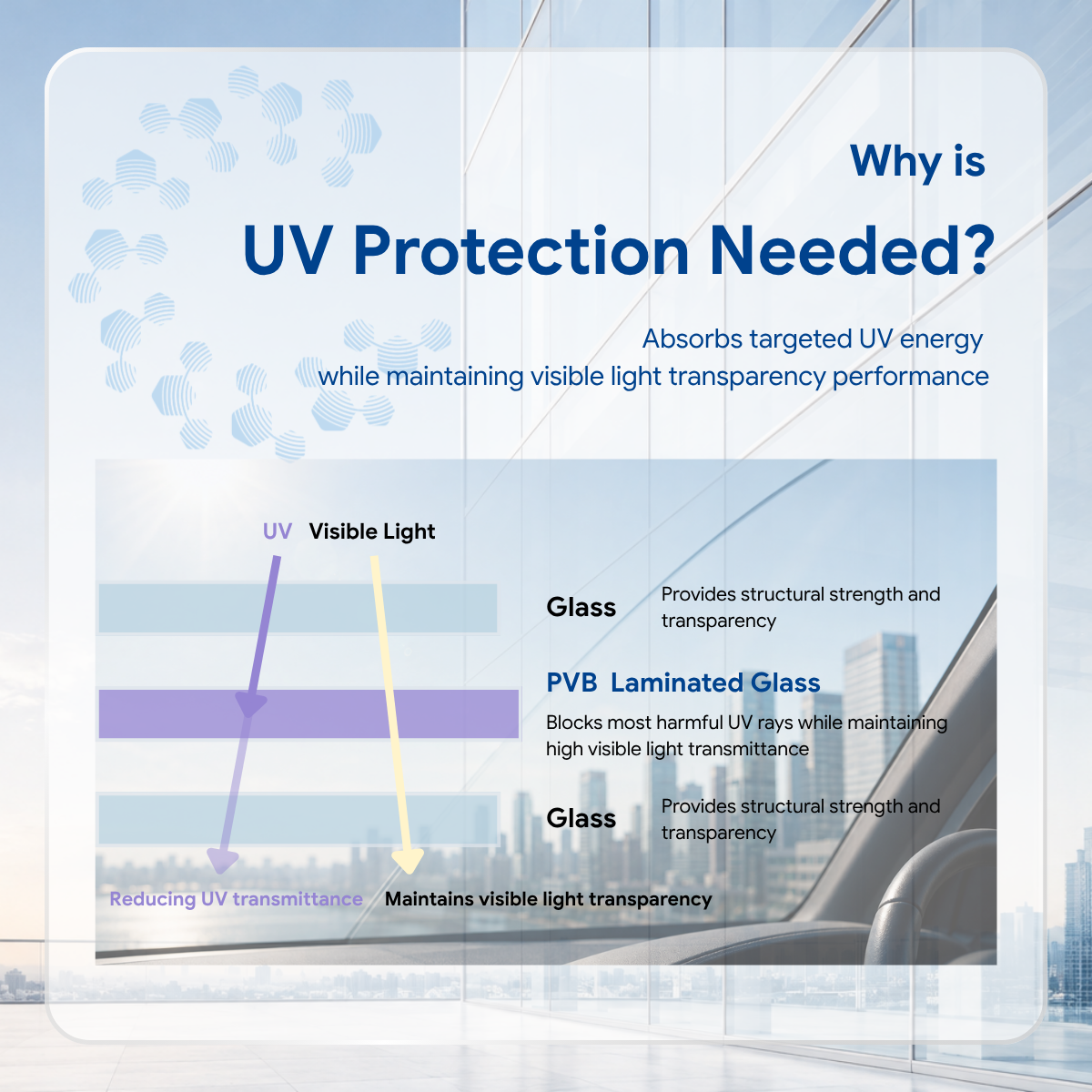
Equally important is managing UV transmittance through the laminated structure.
For vehicles, blocking incoming UV rays prevents premature degradation and fading of interior trim components. For architectural spaces, UV control protects interior furnishings, flooring, artwork, and sensitive displays from solar damage.
Consequently, UV protection in PVB laminated glass has broadened into a tripartite focus: Optical Performance + Material Durability + UV Transmittance Control.
Realizing these performance targets hinges on selecting the right UV absorbers alongside PVB resin and plasticizer systems.
How UV Absorbers Enhance PVB Laminated Glass Protection
Developing formulations for ultra-clear PVB laminated glass requires evaluating UV absorption efficiency, visible light spectrum transmission, compatibility with the PVB formulation, and processing stability under elevated temperatures.
Particularly in automotive windshields, panoramic roofs, and structural building glass, formulators must achieve an optimal balance between blocking damaging UV radiation and maximizing visible light transmittance.
Chiguard® E Series: UV Protection Solutions for PVB Laminated Glass
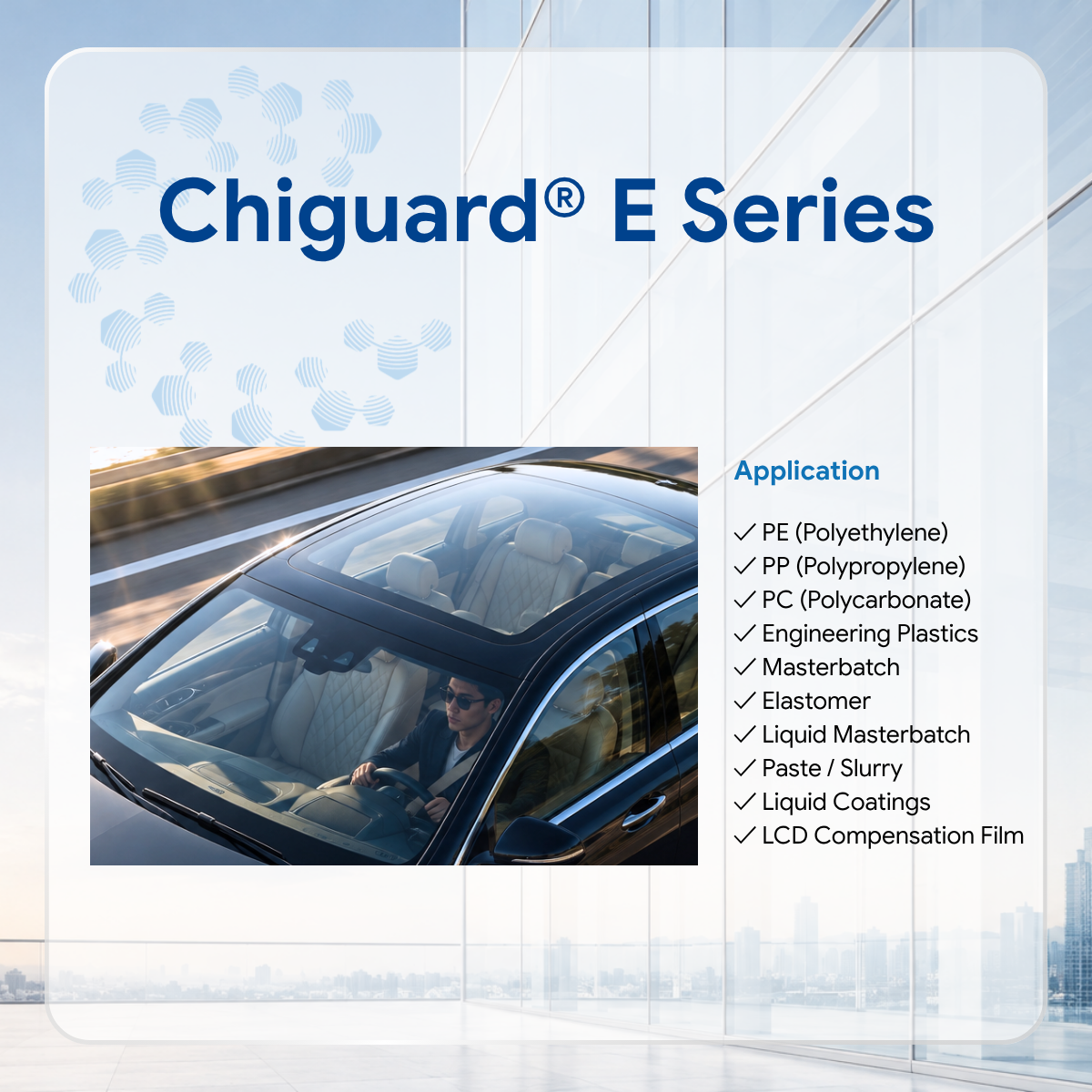
To meet the demanding UV defense and optical requirements of PVB laminated glass, the Chiguard® E Series offers UV absorbers in diverse physical forms, customizable to specific PVB resin formulations, processing conditions, and end-use requirements.
Both options belong to the benzotriazole UV absorber family, demonstrating strong absorption capabilities across the UV spectrum to serve as reliable additives for PVB glass protection.
The Chiguard® E Series goes beyond laboratory-scale evaluations, offering proven integration into commercial PVB laminated glass formulations. Available in both solid and liquid physical forms, these solutions empower material engineers to develop high-performance laminated glass that excels in safety, optical clarity, and long-term UV protection.
Need technical consultation? Contact our sales team at sales@chitec.com
建議您使用以下瀏覽器觀看本網站,
要下載瀏覽器,請直接點擊以下:以獲得最佳瀏覽效果。