
Reshaping Manufacturing Capabilities through Data for Global Competitiveness
Amid global supply chain realignments, the shift toward digital manufacturing models, and heightened international customer demands for quality consistency, batch traceability, and supply resilience, manufacturing capability stands as the core determinant of market competitiveness.
In the specialty chemical sector, product value stems not only from material formulations and performance innovations, but even more from a company's ability to consistently, precisely, and continuously translate R&D breakthroughs into reliably high-quality products. Mastering processes through data, enhancing information transparency, shortening anomaly assessment times, and transforming accumulated experience into transferable corporate knowledge have thus become essential priorities for industry upgrading.
Chitec Technology has long dedicated itself to the research, development, and production of high-performance chemical additives. Its comprehensive portfolio includes UV absorbers, hindered amine light stabilizers (HALS), antioxidants, photoinitiators, and flame retardants. These solutions are widely applied across plastics, coatings, optical materials, electronics, automotive, construction, and high-performance industrial sectors, serving clients across European, American, and Asian markets.
To simultaneously elevate both material R&D and manufacturing capabilities, Chitec Technology partnered with the Digital Transformation Research Institute of the Institute for Information Industry (III-DTRI). Using its Changbin plant as a demonstration site, the company launched its manufacturing digital transformation journey. By integrating IoT devices, Manufacturing Execution Systems (MES), cross-system data streams, and AI analytics, Chitec is step-by-step building a smart factory management architecture tailor-made for the specialty chemical industry.
Why Do Specialty Chemicals Need Smart Manufacturing?
Unlike discrete manufacturing industries characterized by high-volume, standardized output, the competitiveness of specialty chemicals relies on a precise mastery of intricate processes and the ability to consistently replicate product performance.
From raw material feeding, chemical reactions, and temperature/pressure controls, to agitation speeds, reaction times, and final quality inspections—every single step directly impacts purity, stability, and end-use performance. Even with an identical formula, subtle variations in raw material batches, equipment states, or operating conditions can lead to noticeable quality shifts.
Meanwhile, global clients have expanded their supplier evaluations beyond basic product specifications to include regulatory compliance, batch traceability, incident management, supply stability, and holistic quality control. As the market scrutinizes manufacturing ecosystems more rigorously, traditional management approaches reliant on paper logs, fragmented data, and personal experience can no longer sustain long-term enterprise growth.
Chitec Technology's drive toward smart manufacturing is not about chasing technological trends, but directly addressing industry characteristics and global customer expectations. Through data integration, process transparency, and intelligent analytics, the company transforms years of shop-floor expertise into quantifiable, traceable, and repeatable corporate capabilities—building quality upon structured systems, solid data, and institutional knowledge.
Starting from the Shop Floor: Re-examining Operational Workflows
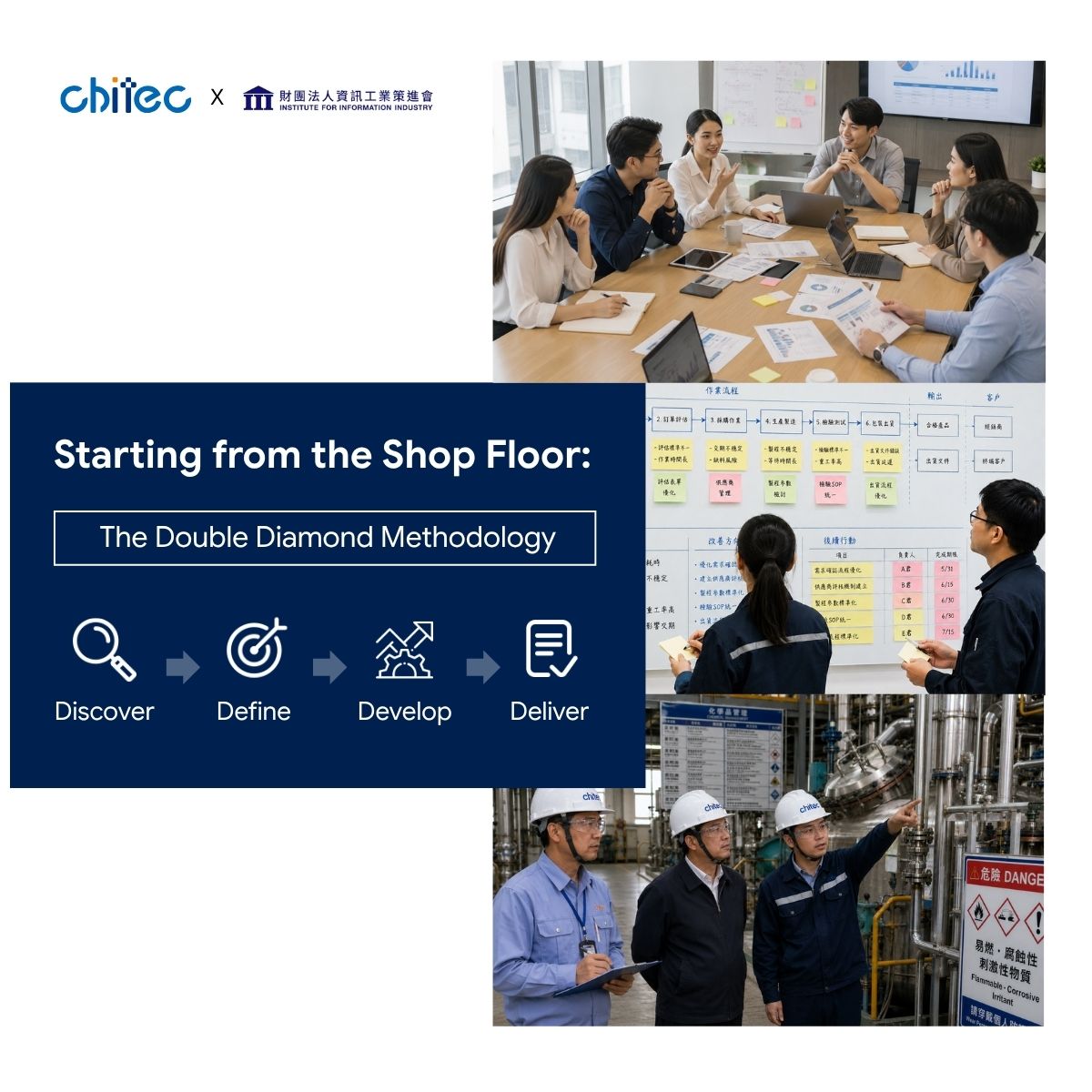
Through interviews with both executive leadership and frontline operators, combined with on-site workflow audits and cross-departmental workshops, Chitec Technology and III-DTRI mapped out every information flow, operational milestone, equipment touchpoint, and quality requirement across the production line.
The project adopted the Double Diamond design thinking framework, progressing through four distinct phases: Discover, Define, Develop, and Deliver. This allowed the team to deeply understand the day-to-day reality of plant managers, process engineers, quality control specialists, and operators, pinpointing the root causes affecting information sharing, process control, and anomaly response.
Rather than simply deploying a standalone software system, this collaboration prioritized seamless coordination among machinery, data, workflows, and people—ensuring that digital tools meaningfully reduce frontline workloads while enhancing situational awareness and decision-making quality.
Identifying Four Major Challenges in Specialty Chemical Manufacturing
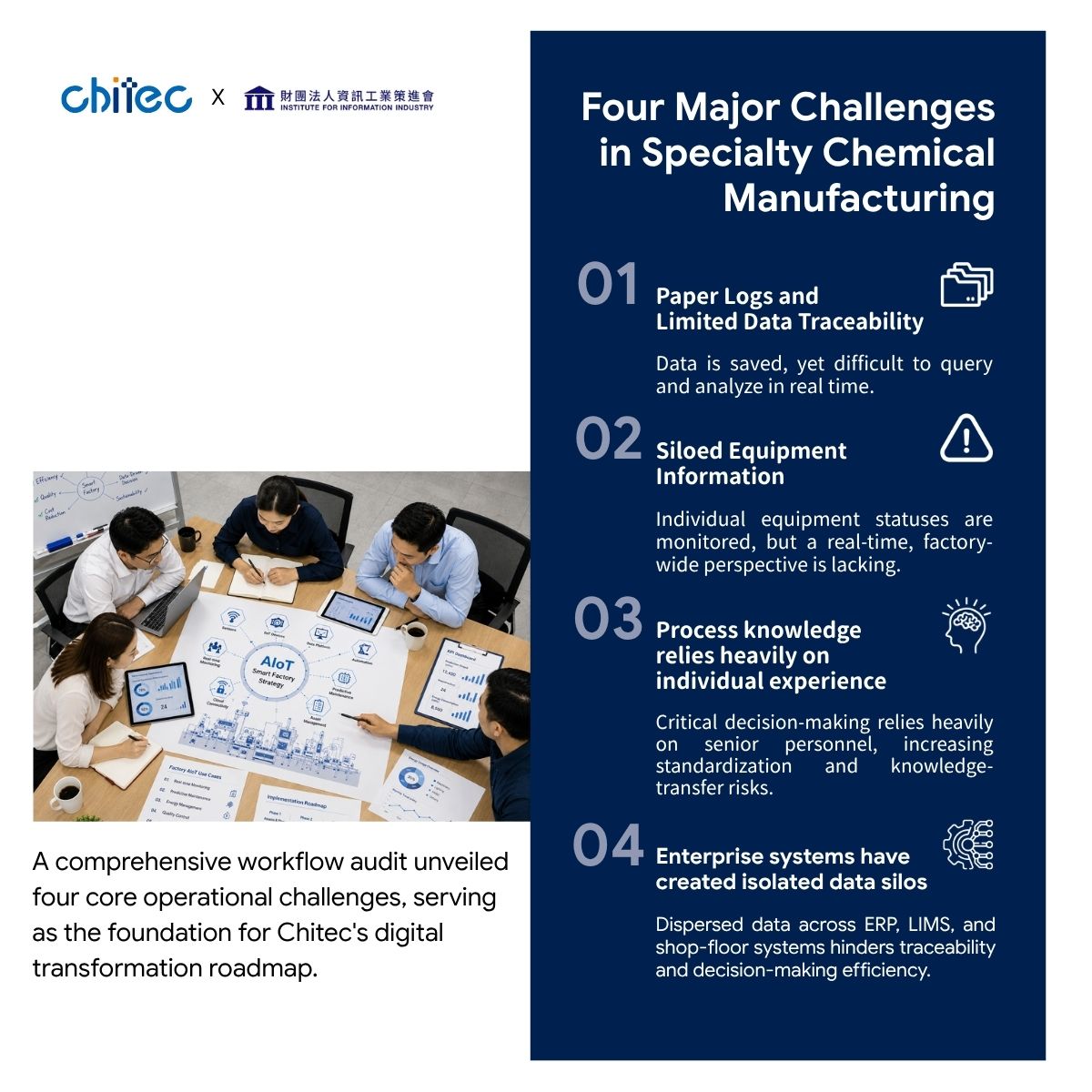
Through this thorough assessment, the project team identified four primary bottlenecks impacting production efficiency and knowledge retention.
First, a portion of production records still relied on paper documentation. When tracing specific production batches or investigating quality issues, managers had to manually collect and reconcile data from fragmented sources—a tedious process that limited the practical value of historical data for continuous process improvement.
Second, operating metrics were siloed across individual machines and standalone interfaces. While plant managers could monitor isolated equipment states, gaining a real-time, factory-wide overview of progress and unexpected disruptions remained difficult, leaving problem diagnosis heavily reliant on manual walk-throughs and cross-departmental coordination.

Third, crucial operational decisions depended heavily on the tacit knowledge accumulated by senior engineers over many years. Relying on individual memory posed significant risks, including lengthy onboarding cycles for new staff, inconsistent operating habits, and the potential loss of vital expertise during personnel turnover.
Fourth, although systems like ERP and LIMS were already in place, the data streams connecting raw materials, production, quality control, and equipment remained unlinked. Managers were forced to navigate across separate software platforms to reconstruct full process contexts, reducing the speed and impact of data-driven decision-making.
Building a Data-Driven Smart Manufacturing Architecture
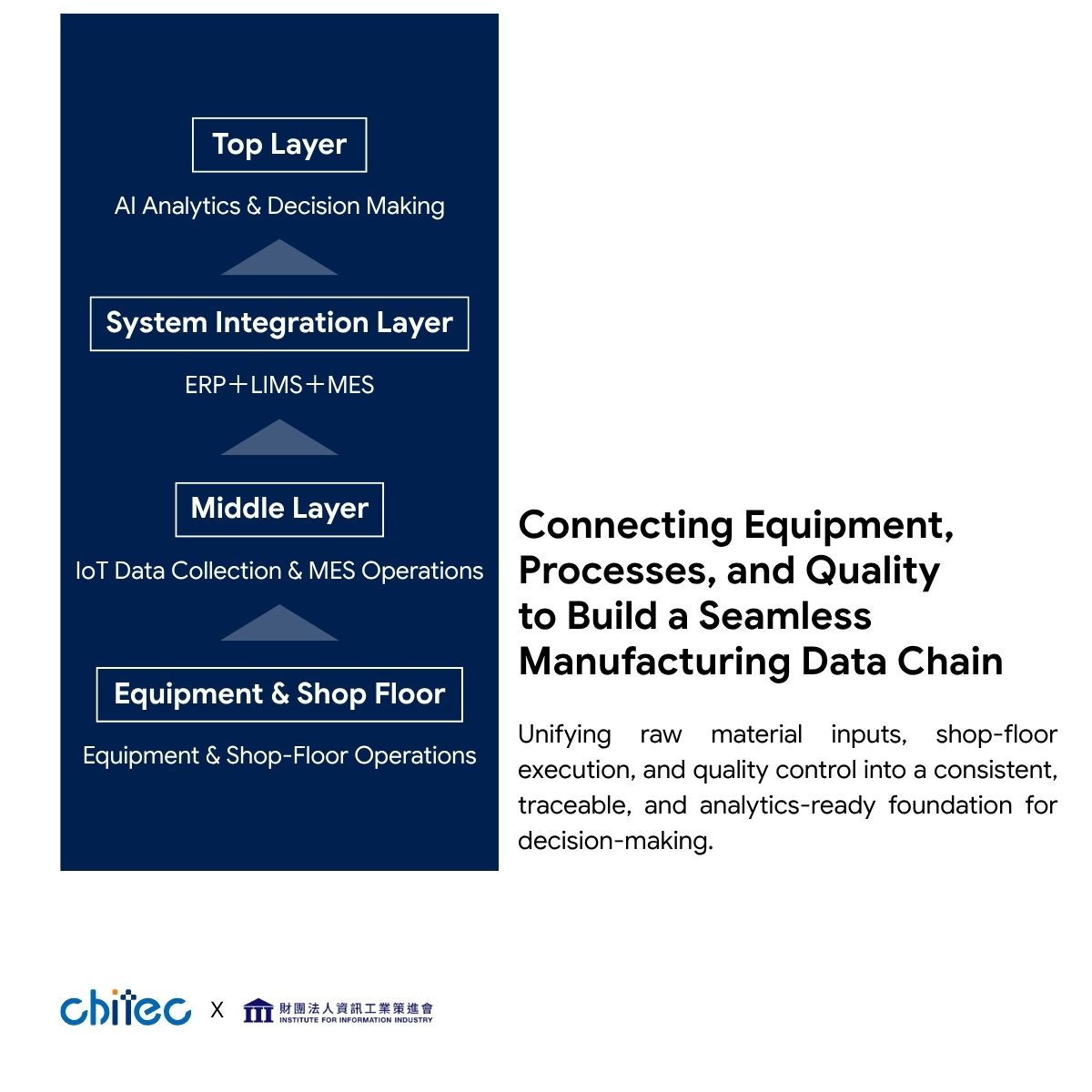
At the equipment layer, IoT technology connects shop-floor machinery to aggregate real-time operating metrics into a centralized monitoring engine, enabling managers to track equipment health, job progress, and system alerts instantly.
At the management layer, the deployment of a Manufacturing Execution System (MES) integrates production schedules, work orders, standard operating procedures, and user permissions, establishing a standardized, fully traceable manufacturing model that boosts cross-departmental agility.
The initiative also connects ERP, LIMS, and MES data streams, linking raw material inputs, real-time processing, and final laboratory testing into a unified digital trail that serves as a shared foundation for quality traceability and analytics.
Building on this consolidated data foundation, the team introduced AI analytics to study historical process parameters. This helps identify key variables influencing product quality, equipping engineers with actionable insights for proactive process tuning and quality control.
The role of AI is not to replace human engineers, but to help them uncover hidden correlations and emerging trends within massive datasets—shifting process management from reactive troubleshooting to proactive early warnings and continuous optimization.
Smart Manufacturing Is Not a System Upgrade, But a Core Capability Reshaping

As these digital initiatives take root, Chitec Technology is transitioning away from manual logs and institutional memory toward a modern manufacturing model driven by data, structured around workflows, and capitalized through enterprise knowledge.
By bringing equipment, process, and quality data onto a single shared platform, production, process engineering, quality assurance, and management teams can collaborate seamlessly. This eliminates information blind spots and accelerates issue analysis, granting the plant greater speed and operational resilience when navigating new product launches, order shifts, schedule adjustments, or quality variances.
Chitec Technology highlighted that this collaboration with III-DTRI represents far more than a routine digital transformation initiative; it marks a defining milestone in reshaping the company's core manufacturing capabilities.
By re-evaluating workflows, bridging machines and software, harmonizing process data, and embedding standardized, knowledge-driven management practices, Chitec Technology is steadily turning years of shop-floor experience into an analytical, traceable, repeatable, and continually improving corporate asset.
From Material Innovation to Manufacturing Innovation
As a global supplier of high-performance chemical additives, Chitec Technology has long cultivated international markets. The company actively exchanges material technologies, market trends, and application needs with global partners at leading international trade shows, including the K Show, European Coatings Show, NPE, CHINAPLAS, and CHINACOAT.
For Chitec Technology, material R&D unlocks the potential of new products, but manufacturing capability determines whether that innovation can be reliably brought to life. Moving forward, Chitec Technology will continue to deepen the convergence of material science, process technology, and digital engineering—advancing smart factories, AI analytics, and data governance. Through precise and dependable manufacturing capabilities, Chitec strengthens quality assurance, global supply, and operational resilience to meet global market demands for high-performance materials, trustworthy supply chains, and sustainable growth.


